
US Vice President JD Vance has strongly criticized commentators for making derogatory remarks about his Indian-origin wife, Usha Vance, following racist comments from a right-wing podcaster.

Since May 10, when Trump announced on social media that India and Pakistan had agreed to a "full and immediate" ceasefire after a "long night" of talks mediated by Washington, he has repeated his claim over 60 times that he "helped settle" the tensions between the two neighbours.

UN Secretary General Antonio Guterres has voiced concern over the violence in Bangladesh, including the lynching of a Hindu man. The UN Human Rights Chief Volker Turk has also expressed concern over the killing of a protest leader.

Newly released Epstein files contain references to 'massage techniques' and Ayurveda from India. The files, released by the US Justice Department, also include photos of former US President Bill Clinton and the late pop star Michael Jackson.
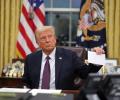
US President Donald Trump signed the National Defence Authorisation Act for Fiscal Year 2026 into law, highlighting broadened engagement with India and addressing the challenge posed by China in the Indo-Pacific region.

The Trump administration has expanded its travel ban and restrictions to 20 additional nations as well as the Palestinian Authority, citing national security concerns.

India strongly responded to Pakistan's remarks on Jammu and Kashmir and the Indus Waters Treaty at the UN Security Council, accusing Pakistan of supporting terrorism and violating the spirit of the Indus Waters Treaty.
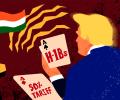
Nineteen United States states have sued the Trump administration over its 'unlawful' decision to impose a $100,000 fee on new H-1B visa petitions, warning that the move will worsen labour shortages in key sectors such as health care, education and technology.

Representatives Deborah Ross of North Carolina, Marc Veasey of Texas and Raja Krishnamoorthi of Illinois introduced the resolution on Friday in the House of Representatives to terminate Trump's national emergency authorising tariffs of up to 50 per cent on imports from India, helping to restore Congress' constitutional authority over trade.
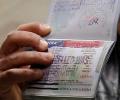
US lawmakers have expressed concerns that policies enacted by the Trump administration, such as the H1B visa fee and tariffs on India, are detrimental to American businesses and threaten the relationship between the United States and India.
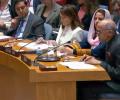
India told the UN Security Council that it calls for a pragmatic engagement with the Taliban, underlining that a focus on only punitive measures will ensure a 'business as usual' approach.
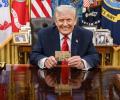
Trump described the Gold Card as a "Green Card, but much better, much more powerful, a much stronger path and a path is a big deal. Have to be great people, but much stronger path", which also helps companies.
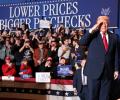
Meanwhile, Trump said Cambodia and Thailand have started fighting again and "tomorrow", he will make a phone call to those countries.

China executed Bai Tianhui, a former top official of a state-owned financial firm, for accepting bribes totaling CNY 1.108 billion (about USD 157 million).

US President Donald Trump has said that India should not be "dumping" rice into the United States market and he will "take care" of it, while stressing that tariffs will solve the "problem" easily.

China has reacted positively to Russian President Vladimir Putin's visit to India, emphasizing the importance of trilateral ties between China, Russia, and India for regional and global peace and stability.

India abstained from a UN General Assembly resolution demanding Russia ensure the return of Ukrainian children. The resolution passed with 91 votes in favor.

The FBI is offering a reward for information about an Indian national wanted in connection with the 2017 murder of an Indian woman and her son in New Jersey. US authorities are urging India to extradite the suspect, Nazeer Hameed.
The Congress party has criticized Prime Minister Narendra Modi following repeated claims by former US President Donald Trump that he brokered peace between India and Pakistan.

The Trump administration said it will conduct a "rigorous" re-examination of all Green Cards issued to immigrants from "every country of concern".
 © 2026 Rediff.com - Advertise with us - Disclaimer - Privacy Policy - Sitemap - Feedback - About us - Terms of use - Grievances